

How to Respond To Racist Comments and A Silent Professor
Photo: Harrison Hamm
By Jolie Brownell
Zoom university. No student asked for this. Most definitely no student sought to pay for something like this. But here we are… in the middle of an ongoing pandemic with over 200,000 lives lost, global turmoil, threats of a second civil war, police brutality, ongoing protests, a new president, etc. Chaotic times, to say the least. For many people, these times have become a matter of life and death. It feels so weird to be students who are still expected to show up to class, complete assignments, and almost act like everything is “normal” (wtf does that even mean anymore?).
Then, on top of all of this, to show up and hear racist, ignorant, and harmful comments made in Zoom-class with no response (or a dismissive response) from a professor is just that more disappointing, frustrating, and invisibilizing.
We already witnessed thousands take to Instagram posting their black boxes — performative allyship at its peak — and have watched individuals “wake up.” Yet, if these times have shown us anything, it’s just how far our country has to go to face the pervasiveness of our systemically racist, capitalist, white supremacist, and settler-colonialist society.
I write this piece to hopefully provide some avenues to confront all this shit in the Zoom-classroom. Yet, I want to note that I am speaking to different audiences. We should understand why it is a very different experience to speak up towards racism and bigotry as a person of color versus as a white person. Just like it is a very different experience for a queer person versus a straight person to speak up against homophobia and transphobia. This distinction does not negate the challenge, anxiety, and negative experiences that non-POC or cis-gendered and/or heterosexual individuals face speaking up… but it’s not the same y’all. If you want to learn more about why, read anything by Ibram X. Kendi, Kimberle Crenshaw, Audre Lorde, Ijeoma Oluo, James Balwin, Angela Davis, etc.
I point this out because these steps below aren’t just for queer/POC, but these steps are also perfect opportunities for “privileged” folks—white/white-passing cisgender and/or heterosexual students—to show up as allies and speak up, instead of waiting or relying on the (usually) sole person of color or “othered” person to do it. These steps are how you can stand up for yourself, show up for others, and find resources if you need help to take necessary action.
What To Do:
Tip 1: Directly Call it out - If you hear someone say a racist, homophobic, sexist, and/or fatphobic, (any bigoted comment) and your professor does not say anything, you can respond by calling it out. This is the most direct way to respond, but for many, this is also the “scariest” option. You don’t know how they will respond, but it can be assumed that they may get defensive or even dismissive.
Tip 2: Pose it as a question - “Is this what you meant to say?” Reframe their ignorant or bigoted comment to give them a moment to clarify what they just said and hopefully correct them. Many times individuals do not realize what they said was ignorant. Doing this may help them catch their implicit bias or blatant racism.
Tip 3 - Call out through Chat - Instead of unmuting yourself and speaking up in Zoom-class, use the Chat function and type out your response there. This can help you both determine what you want to say and how you say it. There are many creative ways to respond, here is a list of a few below:
Pose it as a question - Same as above, you can type out the question, “Is this what you meant to say?” Reframing their ignorant/bigoted comment to give them a moment to clarify what they just said and hopefully fix it.
Post a Resource - Posting a link to an article that directly speaks against the bigoted or ignorant comment can be a slyer way to call out the person. It also shares resources for all students to learn more. You can lead with this phrase or something similar: “[@whoever], your comment reminded me of this super awesome/intriguing article I read about [whatever their bigoted comment was about].” Also, posting a powerful quote by an activist or historical figure that speaks to the comment could also be productive.
Share a Personal Lesson - Depending on if you have the time or emotional bandwidth to do this (looking at my white/white-passing cis-gendered and/or heterosexual peers here), sharing a short personal learning moment concerning the comment can be helpful. Something to the effect of, “You know what, [@whoever], I used to think that too until I read/learned about this…”
Private Chat is a thing - If you didn’t know this yet (and if your professor hasn’t disabled this feature) with Zoom-chat you can secretly chat with someone. This can be really helpful. If you know the person or are more familiar with the person who said such a bigoted comment, secretly being like “Hey, look, what you said was harmful in this way” can be productive while also not calling them out in front of the whole class. It’s similar to taking a person to the side if we were in person. You can secretly message your professor, as well, to directly address them.
Now, what if you don’t have access to Zoom-chat or if it’s your professor who's making the bigoted/ignorant/factually incorrect/racist comments? This gets a bit trickier, but hopefully, the tips below are helpful.
Tip 4: Email after class - You can type up a response after class to let your professor know how such a comment they said or a student said made you or your peers feel. It’s best to not let too much time pass by before sending the email, so the conversations of the class are still in the back of both yours and your professor’s minds. Writing an honest, but respectful email to your professor can start a larger conversation about what took place. Again, I am also looking to my white cis-gendered peers here, because just because a comment was made that didn’t necessarily demean you, doesn’t mean you can’t speak out about it. If a professor receives multiple emails from students regarding what was said, it will be taken more seriously.
Tip 5: Go to another trusted professor or staff member - If your professor does not respond, or you even want additional help figuring out how to approach your professor, receiving counsel from another trusted professor can be helpful. They can provide additional tips and steps you can take to address these problems. They can also point you to who else to reach out to higher up in the hierarchical chain. You may instead want to go to a trusted staff member. For instance, those who work in the Ethnic and Intercultural Services (EIS) can be great resources as many of them are trained to handle these very situations.
Tip 6: Report up - If your professor does not acknowledge your email or provide action steps on how they plan to readdress or resolve the issue, then it is important to know that you can report up. You can either email or speak to the Chair of their department, or even the Dean of the college your class is under.
While these may feel like “extreme” measures for a small bigoted or ignorant comment, research around “minor” events /microaggressions proves otherwise. We all know these comments never come independently, they are reflective of a larger racist, homophobic, sexist, white supremacist culture, and society. Your class environment—yes, even on Zoom—is meant to be one that fosters a safe space for everyone to learn. Silence only condones these problematic behaviors. Doing nothing about it only perpetuates the problem. Don’t let others tell you that these comments aren’t a big deal, this is called gaslighting, which is a super problematic no, no.
What NOT To Do:
While I’m sure there are many other tips that you can do to respond to these comments or a silent professor...here’s something you should stop doing: Hearing a problematic/bigoted comment be made in class, doing nothing about it, and then texting your one Black friend in the class or queer peer in the class something to affect of “I’m so sorry that happened to you/or that you had to hear that…” This is honestly and truly not helpful and low-key calls yourself out. You heard the comment, you were a witness, and instead of sticking up for your peers or speaking out against the comment, you chose to do nothing.
I know while some may appreciate this, others may instead see this response as more about your feelings of guilt for not doing anything, rather than about truly caring about your peers who could be affected by such a comment. If you truly care, reach out AND speak up. Reach out AND email your professor. Reach out AND report it to the Dean.
What Else Can You Do?
Have more tips on how your peers can stand up against bigoted comments in the class? Speak up to silent professors? Please share them in the comments. I know many students will find your thoughts helpful.
Also, please note that this isn’t only about comments made in class. These tips can be used to address other problematic features of the class. From problematic comments to problematic assignments or class materials. Anything that demeans another person, intentionally or unintentionally, needs to be addressed.
Remember, you and your voice have power. You have power. Use it to stand up for yourself and use it to stand up for your peers. Even if you have no people of color in your class, still, speak up. Speak up in your own way. Speak up because this is the first step to addressing the larger issues. Change cannot happen without pointing out where we need to grow. So please, speak up.

#BlackAtLMU organizers are not only fighting for themselves here at LMU and in the United States. They're also fighting for the rights of people in their homelands.
On October 20, 2020, the executive governor of Lagos State, Babajide Olusola Sanwo-Olu, issued a 24-hour curfew in order to prevent citizens from exercising their right to protest against Nigeria’s Special Anti-Robbery Squad (SARS). That same night, SARS shot into crowds of peaceful protestors, resulting in multiple injuries and deaths. Since then, protests have continued worldwide, and the hashtag #EndSARS circulated worldwide on social media, drawing attention to an issue that has been going on for weeks.
In 1992, SARS was formed to combat armed robbery, fraud, kidnapping, and other serious crimes. The unit has been guilty of abusing human rights, killing and torturing innocent civilians, making random arrests, and many other injustices. Nigerians and many others worldwide have decided that enough is enough.
In the United States, the hashtag #BlackLivesMatter circulated widely after Trayvon Martin’s 2012 murder. A few students at LMU have drawn parallels between SARS and the U.S. police.
“The common factor is that Black people are being terrorized by the police. You’d think that in a country like Nigeria, where most of the population is Black, that wouldn't be the case. Well, when you think about the systems that were put in place by the colonizers, when they came to Nigeria, it's not surprising that the police themselves have no regard for life or know that for Black people in general. So, the system’s also putting Black people down and that has to change even though people might not see it that way, because it's a mostly Black country,” said first-year student Odoba Okwuosa.
Student organizations like LMU’s African Student Association and LMU’s Black Student Union did not hesitate to educate and inform others. Though students were grateful for the action taken by these organizations, students felt that LMU as an institution could have shared information from affiliated accounts. They also believed that faculty, staff, and students from LMU could have checked in and reached out.
“How many people from LMU are following me and seeing these protests on my story? Not much,” Okwuosa said. “However, people that are following Loyola Marymount University, if they end up putting out information about #EndSARS, it will reach a larger audience. LMU has Nigerian students, so just checking up on them during these times would be really important because it really feels like they should care more about how people are doing. This could be our family members; this could be our siblings that died. The fact that no one has reached out, apart from faculty and students that I personally know, but just the administration themselves hasn’t reached out or said anything is really telling.”
Junior Dorcas Garba expressed frustration when she tried spreading the word about the protests happening in her home country. “To see a lot of people who were all for black liberation and black justice a couple of months ago, now being silent is self-centered. What I'm asking from them is to make themselves aware, to lend their voice, because we saw how passionate people can get. At the end of the day, it's still a human rights issue, you know?”
The protests have sparked change in Nigeria, forcing concessions from the government such as a mass action calling for a complete disband of SARS and wider police reform. However, this isn’t the first time protestors have heard the Nigerian government make these promises. For LMU students and Nigerian protestors, the fight doesn’t stop here.
“The leaders need to go,” LMU sophomore Ike Agoro said. “It’s up to the people to actually take it seriously because people got quiet really quick. People talked about SARS for like two days and just forgot about it. They shared bloody flags and dead bodies for two days. It’s still going on and it’s up to the people to take it seriously and it's up to them to overthrow that corrupt government because they're not doing what they need to be doing.”
“I do think that all of the attention is going to spark some sort of change. Of course, the corruption did not start today, and it didn't start yesterday, and there are so many facets and angles to it, but this is a starting point of where things begin to turn around and I'm glad that youth are leading this movement. So, I do think that eventually things will get better, but this is just step one out of many that needs to be taken,” senior Yolanda Nosakhare added.
A month later, following the #EndSARS protests, SARS has been undergoing reforms and invoking sanctions on Nigerian officials. According to BBC news, this was the result of a petition brought before the U.K. parliament which was signed by more than 220,000 people. However, this vote to impose sanctions does not hold as much power as it should. Now, they are undergoing an independent investigation to bring justice to the protesters who were killed and abused. As investigations are in progress, Members of Parliament in the U.K. continue to press the Nigerian government for the rights to peaceful protests and respect human rights.


Illustration: Jenica Rose Garcia
Breonna Taylor deserved better
By Isa Coty
On Nov. 13, her first day in Congress, House Representative Cori Bush wore a face mask with Breonna Taylor’s name on it. Her Republican colleagues assumed the name on Bush’s mask was her own and referred to her as Breonna.
“It hurts,” Bush tweeted. “But I’m glad they’ll come to know her name & story because of my presence here.”
It has been 253 days since Breonna Taylor was murdered. After hundreds of days of protesters yelling her name in the streets, the trial for the police officers that murdered her was held, but they were not convicted of anything other than a wanton endangerment charge for firing shots that entered the apartment of a white pregnant neighbor. Due to the intense memeification of Breonna Taylor’s name on social media, many people can collectively remember her image, but Breonna herself was still forgotten by the justice system.
Breonna was murdered in her Louisville apartment by undercover police on March 13. Kenneth Walker, Breonna’s boyfriend, claims he did not hear the police knock, though the officers have testified that they announced themselves after learning that Breonna was a soft target. The officers believed there was no need for the no-knock warrant that they had previously obtained. Kenneth Walker fired a warning shot upon hearing them enter because he was worried that Breonna’s ex-boyfriend, Jamarcus Glover, had intruded. Instead, officers Brett Hankison, Jonathan Mattingly, and Myles Cosgrove returned thirty-two shots into the apartment.
Kentucky Attorney General Daniel Cameron took six months to charge only Brett Hankison with wanton endangerment because Breonna was murdered in a way that was not illegal. The minimal charge is in spite of the fact that the state acknowledged that police misconduct occurred when Breonna’s family won a $12 million dollar settlement.
According to the “Breonna Taylor was Essential” petition and Ben Crum, the attorney for Breonna Taylor’s family, the police officers who murdered Breonna should have been charged with wanton murder instead of with wanton endangerment. There has been vocal public disapproval of what ‘justice’ has been achieved for Breonna Taylor and the rate at which it happened.
Breonna’s name was everywhere, plastered all over social media once her case became public. Her name was spread widely due to #SayHerName, a movement started by activist Kimberle Crenshaw that strives to make the public aware of Black women who are killed by police brutality. On social media, the call to say Breonna’s name as much as possible turned into a trend. Users would pair a quirky picture on Twitter or a cute selfie with the caption, “Arrest the cops who killed Breonna Taylor.” Her name, her story, and her image were all commercialized while her worth was diminished.
When I think about Breonna, I’m reminded of a conversation I had with my roommate Mick about how the belief that justice would be served could only come from a non-Black perspective of the justice system. He said: “Despite all these voices calling for justice, this system is like this unmovable mountain.”
As a Black woman, I especially hurt for Breonna Tayor’s family. As a Black woman, I am Breonna. As a Black woman, I know that if I were murdered by police, I too would not get justice and my name would not be known if it weren’t for movements like #SayHerName.
Breonna Taylor’s murder was not taken seriously because Black women don’t matter to people like the Republicans who mistook Cori Bush for Breonna. To them, we are all the same. The way we get justice for Breonna now is by never forgetting her, as Bush said in her initial tweet:
“Breonna must be central to our work in Congress.”
This is the opinion of Isa Coty, a junior screenwriting major from Atlanta, GA.
Q&A with LMU Survivors: “It is a bigger issue than most people might realize”
Wednesday, November 18, 2020

 |
| Illustration: Daisy Daniels |
Q&A with LMU Survivors: “It is a bigger issue than most people might realize”
By Raven Yamamoto
Content warning: This article discusses issues of sexual assault, harassment, and misconduct.
In early October, a new Instagram page drew attention as it shared gut-wrenching stories of sexual assault, misconduct, and harassment. They had one thing in common: they were all the stories of LMU students.
LMU Survivors is an Instagram page dedicated to sharing the stories of survivors of sexual assault and misconduct at the university. Modeled after similar pages at other universities like USC Survivors and UC Berkley Survivors, LMU Survivors is unaffiliated with LMU and anonymously collects and publishes student testimonies. The page grew rapidly in followers with each new post, leaving many curious about where the page came from so abruptly in the semester.
Agency was able to get in touch with the founders* of LMU Survivors and ask them some questions about why they started the page, what the community’s response has been like and what they believe LMU can do better to prevent sexual misconduct.
What inspired you to start LMU Survivors? Why now?
We were inspired to create this page after realizing there wasn't a space for the LMU community to share their experiences with sexual assault and misconduct. One of us is a survivor and felt passionate about crafting a safe space for people to share without judgment, anonymously. Overall, we wanted to create a space where people felt like they could share their story without fear of retaliation, and have it be a cathartic and freeing experience. We also wanted to create the page to raise awareness and show that sexual assault happens on our campus and [that] it is a bigger issue than most people might realize.
Did the changes to Title IX regarding how colleges can respond to complaints of sexual misconduct on campus motivate you in any way to make these stories heard?
Title IX changes were definitely a catalyst to creating the page. We think that the changes to Title IX make it more difficult for survivors to feel comfortable reporting and sharing their stories. These stories are already so incredibly difficult to share, so we wanted to give survivors an option to share without feeling the pressure of filing a report if they do not wish to do so.
How has the response been? Have you received any comments or messages of support, any pushback, etc.?
The response to our page has been amazing, and we have received so much support. We receive DMs thanking us for creating this space, telling us how cathartic just the act of writing down their story was, and offering us suggestions for how we can grow and expand moving forward (like adding resources) — which we so appreciate. There has been some pushback when we have posted stories that reference fraternities. However, our response is that we have no affiliation to LMU, and therefore we have no obligation to LMU Registered Student Organizations. We simply serve as a vessel for survivors to share their stories, so we publish them verbatim unless we are expressly asked to edit them by the survivor.
Tell me about the submission process. About how many submissions have you gotten since starting the account and how can people share stories of their own? Is it only limited to students or open to all members of the LMU community?
Our submission process is through an anonymous Google form which is linked in our Instagram bio. We do not collect emails or any personal information. The form asks whether or not you want comments turned on or off when we post your story, and then has space for you to type as much or as little as you want. Any LMU community member who has experienced sexual assault or misconduct who would like to share their story is welcome to do so. We were honestly not expecting that many people to share so quickly, but we have received 40 submissions over the past month since we started, and get new submissions at a pretty steady rate. We are both happy at the fact that so many people feel comfortable sharing, but also reminded that this is a real issue in our community.
How do you think LMU can improve awareness and/or prevention of instances of sexual assault and harassment on campus? Do you think they're doing an adequate job as is? Why or why not?
We think LMU can definitely improve awareness and prevention of sexual assault and harassment on campus. While the two go hand in hand, more preventative measures should be taken. A lot of times, LMU does not take survivors seriously or cases seriously; even when there are resources provided, sexual assault gets quickly swept under the rug in order to protect LMU's image. In reality, it's the students that deserve to feel protected. We think the conversation needs to continue after the freshman orientation classes and there needs to be more communication, clarity, and awareness surrounding LMU's reporting and hearing process.
*The identities of the founders have been kept anonymous at their request.
Okay, So “All Latinos Are Lazy.” But what does that actually mean for you?
Wednesday, November 11, 2020


I recently listened to Brene Brown’s Podcast “Unlocking Us,” where she interviews Ibram X. Kendi about his recent book titled “How to Be an Antiracist.” During the Podcast Kendi explains how stereotyping, or what he calls the “personalization of groups,” is when groups are given individual characteristics that turn out to be vastly false. He uses the common stereotype of the Latinx community being “lazy” as an example of this. Instead of reiterating everything Kendi said by explaining how racist and false these stereotypes are, I want to try another approach. What if, just for this moment, we accepted this stereotype to be true: “All Latinos are lazy.” What are the actual implications for us (non-Latinx) if we accept this?
Okay, So They’re Lazy...Now What?
This stereotype (I mean, now truth) that all Latinx people are lazy, in most cases does not stand alone. I mean that the laziness of these people is almost always used as a justification for something. For instance, “Build a wall so the lazy immigrants don’t come in!” or “All these lazy undocumented aliens just want to get our government benefits.” The point is that these people are not “worthy” of access to certain benefits or even an entire country because they are lazy. Lazy, then, has become synonymous with an assumed lack of moral and work ethic and therefore should not be condoned or supported by any benefits.
If you accept everything above as true, then you have already accepted another bold belief: the productivity of a body is more important than the existence of such a body. To say a person should not have access to a country because they are lazy, is to already understand, accept, and condone the fact that this country prioritizes the ability, efficiency, and performance of a body more than its human life. If they are lazy and cannot produce (profit) or are unwilling to work, then they are not deserving of any benefits. In other words, we have come to base the worth and desirability of a person on what they can do.
What Does This Mean for You?
Here, then, is my question to you: is this how you understand the U.S. to be? If so, are you okay with this? Are you okay with living within a society that prioritizes what you can produce for it over your very existence? Are you okay with having to earn your basic rights and benefits (such as affordable food, safe housing, second chances, good schools)? Are these things we must earn in the first place? ...Or does simply being a human alone, not already make you worthy of such rights? Are you, being human alone, not worthy of this?
Pushing even further, where do you think we learned to fuse together the worth of a person with their productivity? Does this feel natural to you, or learned? conditioned? Do you believe that living in the U.S. with a capitalist economic system (which prioritizes profit) has shifted our understanding of what it means to be human? …Do you want to continue living in this kind of society or would you prefer one where you could do nothing, be lazy and still be every bit as deserving of basic human rights? If this still feels wrong to you, I highly suggest you dig deeper into why.
The things these “lazy” people are fighting for are basic human rights. So to say that they must earn their rights by working… is almost like saying they must earn their way to being considered as human. Eww! I hope that made you cringe as much as it made me typing this.
Don’t Just Stop Calling them Lazy, Start Allowing Them To Be
I have heard this trope said about the Latinx community my entire life. I even remember back in middle school asking some of my Latinx peers about why they “goofed around” and didn’t pay more attention to the teacher at times (I know, I realize now how I played right into this stereotype). But what shocked me back then was their response: “Why should we work hard, get A’s, when no matter what we do, everyone else will still see us as lazy and undeserving.” I also know all too well how this stereotype has been used upon the Black community (i.e. Welfare queen or lazy Black people trying to scam the system instead of working harder).
The truth is, are there lazy individual Latinx people? I am sure they are. Am I lazy sometimes? Most definitely yes!! Do you feel lazy some days? I’m sure you do. But, it doesn’t feel right to dismiss an entire group of people as lazy just as a quick way to disqualify them of rights… especially if these very rights shouldn’t be earned through productivity in the first place.
So what I hope you take away from this, is that yeah we should probably stop stereotyping people and entire communities. But also, I want you to take it a step further. What if we allowed each other to be lazy? What if we remove the moral compass around productivity and just allow each other to rest and create entire lives that aren’t centered around productivity, efficiency, work, and profit? What kind of society would this create? What new liberations would this bring for you?
We should be allowed to rest, to not want to work our whole lives, to be lazy. We should all be given the freedom to just be. human. and supported.
Also, just FYI, to deem an entire group of people lazy, while refusing to understand the complexities of their disparities, is actually quite lazy too ;)

by Harrison Hamm
As a queer, biracial son of a Filipina immigrant, the rights of myself and those I love are frequently challenged by so-called “political opinions.” This is now happening at LMU.
The “political opinions” I reference are not merely sociopolitical or economic ideologies belonging to either the right or left. Rather, I use the term “political opinions” in quotes to identify violently prejudiced beliefs dangerously justified through political rhetoric (i.e. anti-LGBTQ rights, pro-immigration control).
Anti-LGBTQ rights or pro-immigration control stances are not simple opinions, devoid of tangible impacts on bodies. In fact, these beliefs intensely impact bodies, lives, and communities of human beings. It is easy to say you support “pro-border security.” It is less easy to say you support “incarcerating children and forcibly sterilizing women.” Through rhetorical coding, the serious and real actions that follow “political opinions” are too often overlooked. We cannot overlook these here on the Bluff, especially now.
On October 11th, ASLMU Senator Stephanie Martinez was impeached on the grounds that her actions “severely damaged the integrity or authority of ASLMU or the office held by the individual in question.” To further specify the grounds of impeachment, complainant Senator Camille Orozco clarified that the hearing was not a challenge to free speech.
“I would like to remind everyone that this is not a trial regarding freedom of speech, expression, or political affiliation, as those rights are protected in the United States Constitution, as well as the non-discrimination policy in ASLMU’s constitution,” Orozco said. “This hearing is one regarding conduct which has severely damaged the integrity, or authority of ASLMU or the office held by Senator Martinez.”
Challenging Orozco’s reminder, Senator Martinez expressed her belief that the trial was entirely an issue of free speech.
Martinez argues, “Despite what was stated, that this is not about free speech or political identity, I argue that this is not the case. The impeachment case against me was brought forward as a result of the Loyolan article and subsequent petition in response to my creation of the students for Trump Instagram page,”
Called to her defense as a witness, Scott Meyers supported her assertion that this was a free speech issue. “I think a lot of what conservatives stand for is freedom of speech, and I believe that this is entirely a free speech issue,” said Meyers. “I see people being affected or harmed by an opinion.”
And there’s our buzzword: “opinion.”
So what do we make of this argument? Was Martinez impeached for creating distrust between the very students her role as Senator for Diversity and Inclusion is tasked to protect? Or, was Martinez impeached for her “opinion?”
Veronica Backer-Peral of The Loyolan answers this question in a recent article, questioning the constitutional and ethical integrity of the impeachment.
She argues, “Even if you disagree with everything that Senator Martinez believes and stands for, it is evident that she was impeached for tweeting her opinion.”
While Martinez, Backer-Peral, and other critics of the impeachment claim an “opinion” was under politicized scrutiny, I implore us to question the meaning of “opinion” in this context. The opinion in question is not merely an ideological alignment with right-wing politics. The “opinion” being discussed is not an opinion at all. It is a violent, dangerous, and alienating message to the communities Martinez’s role requires she protect.
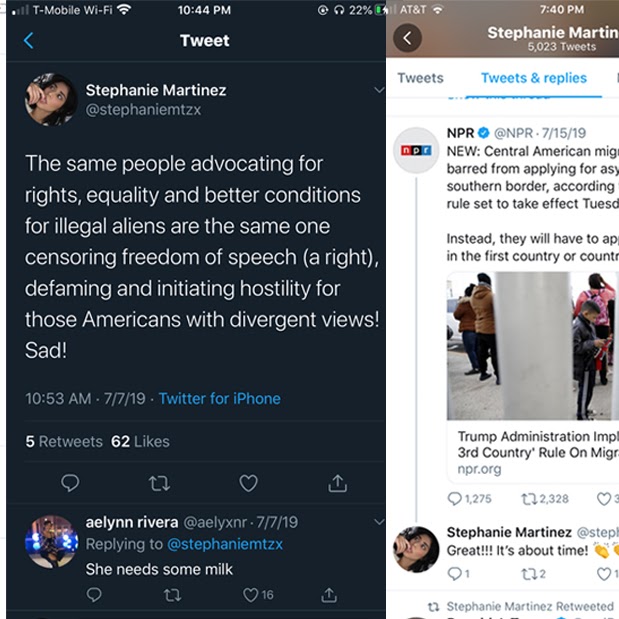
Martinez was not impeached for an “opinion.” She was impeached for damaging the integrity of ASLMU not by openly supporting “pro-immigration control” - but for supporting violence on the lived realities of our most vulnerable students. These marginalized communities, such as queer folks and undocumented immigrants, need a Senator for Diversity and Inclusion who has their best interest in mind. Martinez’s hateful and violent actions directly contradict this duty.
To retweet “My child will NOT be learning LGBT curriculum” is to deem queer students at LMU as unimportant and not worth hearing or learning from. To retweet this exclusion of LGBT folks is to isolate us, to devalue our lives, and to curate a world without us. That is why Martinez was impeached. We, the student population she is supposed to protect, feel unsafe under her leadership.
To tweet “A close friend of mine works for ICE” is to align herself, and by extension ASLMU, with the endangering of communities of color, the imprisonment of children, and the mutilation of women’s bodies. Martinez’ parents’ legal immigrant status does not absolve her of this. My mother is a legal immigrant too; however, I know that to tweet about a friend in ICE is to support violence against students at LMU.
Martinez was not impeached for her political views. ASLMU’s majority voted to impeach her because she tarnished the integrity and authority of the governance of our student body. As a queer son of an immigrant, I do not trust Martinez. Though she stated that the LGBT community at LMU “would have” her support, I am here to say no.
My human rights are not a political opinion. Neither are the rights of the LMU student body.
Though Martinez was impeached for creating distrust between students and ASLMU, it is imperative that we as a university push back against the insistence on this as an issue of free speech or political affiliation. We can disagree about new logos versus old logos. We cannot disagree about our student communities’ human rights.
This is the opinion of Harrison Hamm, a junior Screenwriting & Women’s and Gender Studies double major from Jackson, TN.

by Spencer Miller
When applying to universities as a transgender/nonbinary student, there are certain factors that one must consider that the average student does not. Every school is not created equal, and this is shown by the staggering differences in protections and support for LGBT+ students that certain schools have. Among LGBT+ students, transgender students are particularly vulnerable. Transgender murder rates have risen this past year with at least 33 dead compared to last year’s 26, and sexual assault and abuse rates remain terrifyingly high.
LMU is a private Jesuit university, and the Catholic Church’s official stance on transgender and nonbinary identities is not one of acceptance, despite how Catholics are asked to be respectful and loving of everyone in verses such as John 15:12 and 1 Peter 4:8. However, LMU received a four out of five star rating on Campus Pride’s Index, which rates the inclusivity, safety and acceptance of LGBT+ students at schools across the U.S. With that in mind, here are some of the specific policies and procedures that affect transgender students on LMU’s campus.
Housing
One of the draws of university life is the independence that comes with living on your own. University housing is a commonly shared experience, with 94% of LMU’s freshman class living on campus pre-COVID. Transgender students in particular use student housing to move out of unaccepting households and begin their transition process both socially and physically, as well as leave an environment that may be abusive due to their identity.
Currently, LMU does offer co-ed housing, but dorm rooms are separated by gender. While there are no official documents specifically addressing housing policies for transgender students, section IX of LMU’s Student Housing Policies prevents guests of the opposite sex from occupying a student’s room from the hours of 2:00 AM and 8:00 AM. By creating rules based on biological sex rather than gender, LMU’s policies can make transgender students feel uncomfortable, leading to situations such as awkward encounters in communal bathrooms, difficulty finding roommates, and an overall sense of being an outsider within the living space.
Due to the current pandemic, student housing on campus is severely limited. There has been no evidence that transgender students’ specific needs have been taken into account, or if there has been any bias for or against transgender students when selecting the students allowed to remain on campus this semester.
Healthcare
Adequate healthcare is important for all students, but it is especially critical for transgender and nonbinary students. Many transgender and nonbinary people choose to physically transition in order to lessen gender dysphoria, and hormones and surgery can be costly without the help of insurance. In addition, due to gender discrimination and dysphoria, many transgender and nonbinary people suffer from depression and other mental illnesses with 40% having reported attempting suicide at least once in their life in 2015.
LMU’s offers student health insurance under Aetna Student Health and covers a variety of services, including transgender-specific care. Some of the specific services they provide are inpatient and outpatient care for surgeries, mental health office visits relating to gender dysphoria, and hormone and speech therapy. All of the services by Aetna are covered the same way and with in-network doctors, insurance covers either covers 80% of costs or 100% of costs with a small copay, which is the same as similar procedures that are not specific or exclusive to transgender and nonbinary patients.
Harassment Policies
Transgender and nonbinary people are particularly vulnerable to prejudice, discrimination and harassment due to their gender identity, biological sex and gender expression. The comments made and actions taken due to stigma and the intolerance of their peers has a large effect on their mental health and impacts their ability to obtain an education.
LMU has explicit anti-discrimination policies regarding prejudice on the basis of sex, gender identity, and gender expression. These policies also take a hard stance against any bias-motivated incidents or hate crimes relating to a person’s perceived gender. According to LMU’s 2019 Safety Report, no hate crimes have been committed against transgender students on campus between 2016 and 2018, though there is no section within the report regarding bias-motivated incidents.
In addition to anti-discrimination policies, LMU also has developed an Implicit Bias Initiative. Since 2018, all incoming first-year students have been required to attend implicit bias workshops created by LMU CARES to prevent discriminatory acts against minority students, but there are no formal reports on whether they are effective. No data on how safe transgender students feel at LMU have been collected at this time.
Restrooms
The common “restroom debate,” or the argument about whether transgender people should be able to use the restroom that corresponds with their gender rather than their sex assigned at birth, has been a prominent fixture in transgender rights policies. Many public facilities have been implementing all gender or gender-neutral restrooms and single-stall restrooms to be more inclusive to both binary transgender people and nonbinary people, who do not identify as either male or female.
In a message from the Office of the President from 2016, President Snyder announced that “Student Affairs is working with Facilities Management to create additional all-gender restrooms by fall 2016.”
While these all-gender restrooms on LMU’s campus do exist, they are not marked anywhere on multiple official maps of LMU’s campus, including the General and Interactive maps for the Westchester Campus. This makes it difficult for transgender and nonbinary students to identify safe places for them to use the restroom without discomfort. In addition, there are no all-gender restrooms available in the majority of dorms.
Scholarships
Cost of attendance is often a large factor when deciding what university to attend. The transgender community as a whole experiences high rates of poverty in the U.S. due to discrimination and, in many cases, being cut off from their families from a young age. Because of this, pursuing higher education can be difficult financially for many transgender and nonbinary students.
LMU currently has a list of scholarships and scholarship tools available to students. However, LMU has no official scholarships of their own specifically geared toward or exclusively for transgender and nonbinary students or LGBT+ students in general. This acts as a barrier for many transgender/nonbinary students pursuing a degree at LMU that would benefit from their financial support and could cause many LGBT+ students to transfer or attend different universities.
General Resources
LMU has an LGBT Student Services office (LGBTSS) that provides a variety of services and resources for LGBT+ students, including transgender and nonbinary students. Some resources include one-on-one and group counseling through LGBTSS or through Student Psychological Services (SPS), providing a space for transgender and nonbinary students to discuss their issues and receive assistance with mental and emotional trauma. LGBTSS holds both educational and social gatherings and workshops to help engage straight and cisgender people in discussions about the LGBT+ community and allow for LGBT+ students to interact and strengthen community ties with each other.
Summary
LMU has many services in place for their transgender and nonbinary students, especially with regards to anti-harassment policies and healthcare for transgender-specific needs. However, the university lacks proper facilities for transgender and nonbinary students with regards to housing and restrooms on campus. While the university has been making progress, there is still room for LMU to grow to become a truly safe and welcoming environment for its transgender and nonbinary students.


Social Icons