
Showing posts with label immigration. Show all posts
Showing posts with label immigration. Show all posts
Anti-immigrant Tweets from ASLMU Diversity & Inclusion Senator’s Past Cause Concern
Monday, May 4, 2020

| |
|
Anti-immigrant Tweets from ASLMU Diversity & Inclusion Senator’s Past Cause Concern
 “They’ve lived in many years of fear and worry,” Nelson said. “The fact that I could lose them, makes me emotional to think about it.”
 On the student level, ASLMU’s three Diversity and Inclusion Senator positions were created to serve LMU’s marginalized and minoritized students, including undocumented and DACA students. The ASLMU Bylaws state that the role of a Diversity and Inclusion Senator is to “represent the varying needs and issues related to identities including, but not limited to, gender, sexual orientation, culture, disabilities, and neurodiversity.”
By Raven Yamamoto, Robyn De Leon
Rarely a moment goes by that LMU senior Lilith Nelson* isn’t thinking about the safety of a loved one who is undocumented. Under the Trump administration, over 69,000 migrant children are being held in immigrant detention and the U.S. Immigration and Customs Enforcement (ICE) still has federal jurisdiction within and even beyond our U.S. borders to deport undocumented people.
This familiar sense of fear resurfaced for Nelson when she learned of anti-immigrant tweets posted by LMU’s Diversity and Inclusion Senator Stephanie Martinez last year.
 “They’ve lived in many years of fear and worry,” Nelson said. “The fact that I could lose them, makes me emotional to think about it.”
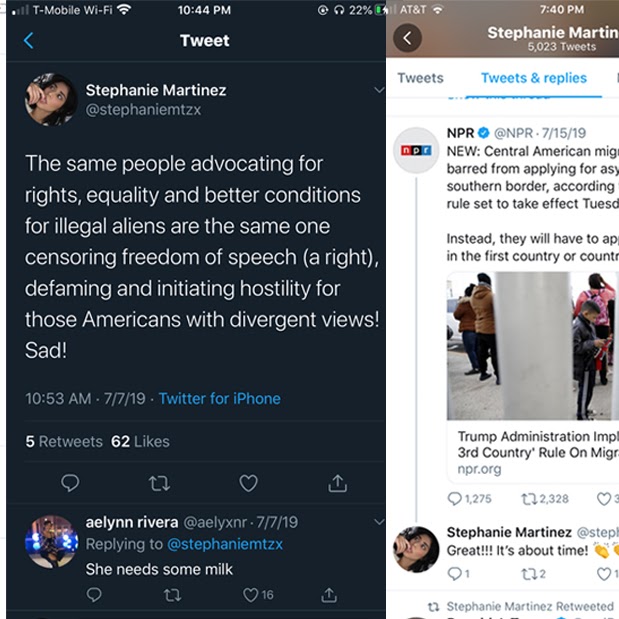
In one tweet, Martinez wrote, “the same people advocating for rights, equality and better conditions for illegal aliens are the same one censoring freedom of speech (a right), defaming and initiating hostility for those Americans with divergent views! Sad!”
Another tweet she made in response to another user reads, “a close friend of mine works for I.C.E.. and they can take you in if you have no legal papers, I, however, am a citizen.”
Martinez also retweeted an NPR article about Trump’s ‘Safe 3rd Country’ Rule that would bar migrants who have traveled through another country before arriving in the U.S. from applying for asylum, with the caption “Great!!!! It’s about time!”
There are at least 20 undocumented students at any given time in the undergraduate student body and the actual amount is likely higher. This includes potentially undocumented students and Deferred Action for Childhood Arrivals (DACA) recipients.
On an administrative level, LMU expressed support for its undocumented students and DACA recipients in response to the removal of DACA by the Trump administration in 2017.
“Our Catholic, Jesuit, and Marymount identity offers a solid foundation from which we can confront any adversity or challenge to inclusive educational excellence,” President Timothy Snyder said in his We Stand with Dreamers Letter. “We will continue to advocate publicly for our undocumented students."
LMU is also part of the Ignatian Solidarity Network (ISN), a network of Jesuit schools and universities in the United States committed to social justice, including the protection of DACA and their undocumented students.
 On the student level, ASLMU’s three Diversity and Inclusion Senator positions were created to serve LMU’s marginalized and minoritized students, including undocumented and DACA students. The ASLMU Bylaws state that the role of a Diversity and Inclusion Senator is to “represent the varying needs and issues related to identities including, but not limited to, gender, sexual orientation, culture, disabilities, and neurodiversity.”
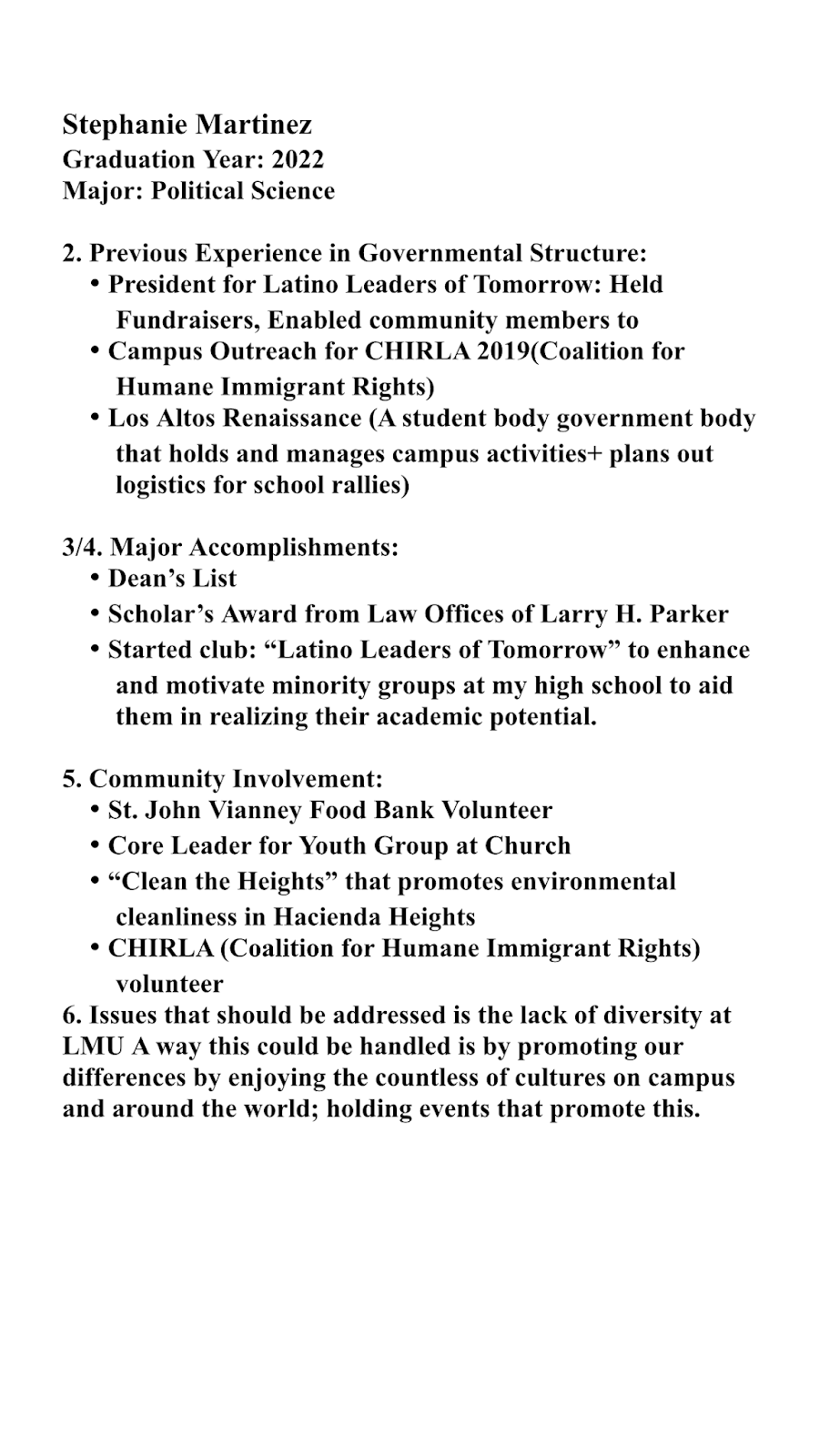
In late March, Stephanie Martinez ran for the position, listing involvement as a volunteer with the Coalition of Humane Immigrant Rights of Los Angeles (CHIRLA), an organization for the support and protection of the undocumented community as a qualification for the position, in her platform statement.
In early April, Martinez was elected alongside Camille Orozco and Isaac Hernandez as a Diversity and Inclusion senator. All three ran uncontested. Only two senate seats were contested this election cycle, according to former ASLMU Elections Chair Abigail Mannullang. Only 41% of the student body participated in this year’s election, compared to the usual voter turnout of 50-60%.
In an email interview with Agency, Martinez expressed regret for having made these tweets.
“I owe the students at Loyola Marymount University a sincere apology for the severity and ignorance of my tweets. I am extremely regretful for the aggression that transpired on my social media platform,” Martinez said. “I am not the same person as I was a year ago.”
Martinez attributed her usage of the phrase “illegal aliens” to the Department of Homeland Security’s definition of immigrants.
“I was simply referring to the term they use,” she said. “I would not use this phrase to describe undocumented students at LMU.”
In response to her tweet regarding I.C.E., Martinez said, “My intention was to inform her that I.C.E. agents can only take you in if you have no documentation, which I stated to have. Unlike [the user I replied to], I will never go to the extent to call I.C.E. on individuals.”
Martinez also explained how her experience working with CHIRLA, per her platform statement, inspired her to stand in solidarity with immigrants.
“At CHIRLA, I went on protests to bring attention to the unjust measures Trump was pursuing to end the program. I also had the opportunity to interact with DACA recipients and hear their stories. ” Martinez said. “It is appropriate to say that gaining exposure and learning about this at a micro-level has personified these issues for me; thus, [it] has motivated me to use my privilege to advocate for immigrant rights.”
 |
Martinez’s Twitter account was public at the time that these screenshots were collected by Agency. It has since been made private.
Orozco and Hernandez expressed discomfort about their new colleague’s tweets.
“Senators are elected by the student body and are responsible for respecting and advocating for their constituents,” said Orozco. “They should be held accountable when their words and actions are in conflict with the communities they were elected to represent.”
Hernandez acknowledged that while he does not know Martinez personally, he feels her past comments are harmful to the undocumented students, DACA recipients, and migrant students within their constituencies.
“While we have to respect that people have different points of view, I do think it’s contradicting [to] her senator position as someone who is supposed to speak for vulnerable and marginalized communities,” Hernandez said. “I think there’s no doubt in that.”
After the Trump administration rescinded DACA in 2017, ASLMU wrote an open letter in support of undocumented students and signed onto the Jesuit Student Body President’s Association’s joint response.
In the same year, former student body president Hayden Tanabe signed the Director of Undocumented Student Services position into the ASLMU Bylaws. This position was implemented during Alo Coleman and Brenda Quintanella’s administration in 2018.
“When you lack visibility, you lack advocates and you lack people that are willing to fight for you and fight for,” said former ASLMU Vice President Quintanilla. “To have a specific representative in ASLMU, who is [in] student government for all students, assures that there’s always going to be at least one person who is willing to advocate for this specific community— regardless [of whether] they know who is in the community or not.”
Quintanilla is also DACAmented, meaning she received protective status in the U.S. through DACA.
“Our identities rely on living in the shadows,” Quintanilla said. “Our identities rely on secrecy and keeping our private life private and not sharing our status with people.”
Former Director of Undocumented Student Services and DACA recipient Lizbeth Ramales Arango expressed her disappointment seeing these posts made by a member of the Senate.
“It honestly disturbs me because [of] the fact that she is talking about her classmates, students around her [and] people that sit next to her,” Ramales Arango said. “How are you gonna say those things and make me feel like I don’t belong?”
LMU students have been working alongside ASLMU to protect each other and support their undocumented peers. Resilience is a student activist group that has long fought to support immigrant students on campus.
Resilience President Desiree Diaz said, “if you're not going to speak for all of the people, especially minorities and the people who are struggling the most, especially right now, why would you go out for [this position]?”
Resilience Vice President Camilia Pierola recalled the resignation of former ASLMU Senator Katie Porter after she made a controversial Snapchat about “lower socioeconomic minority students” that were visiting campus.
“I wasn't surprised. But at the same time, I was surprised that it was happening again because we've seen this situation before in ASLMU,” Pierola said.
Former Diversity and Inclusion Senator Vandalena Mahoney wrote the articles of Porter’s impeachment. Porter resigned after receiving intense backlash from the community before the impeachment proceedings began. Mahoney gave ASLMU an ultimatum, saying that she would quit if Porter was allowed to keep her position as Senator at Large.
“If you’re going to allow someone with those mindsets, those ideals, and her privilege to do that, then you are not looking at your initiative,” Mahoney said. “It was more of a statement to the university, rather than her feeling bad about herself or us kicking her out, it had really nothing to do with her personally it had everything to do with the type of people the university empowers versus who they don’t empower.”
Mahoney explained that she was not surprised to hear that a similar situation had arisen with Martinez’s social media posts but reiterated the need to hold senators accountable.
“If we're going to talk about what it means to hold a position like that, people with that rhetoric are not suitable for that position,” Mahoney said. “Maybe another position, but not Diversity and Inclusion.”
Martinez explained that she does not agree with “the caging of children” or the “separation of families” and is in full support of the Jesuit backing of DACA.
“I am pleading with the students at LMU, to not take me as a threat,” Martinez said. “Acquiring this position will allow me to learn and grow and most importantly, create a safe environment for marginalized students.”
ASLMU’s newly elected President Jack Palen and Vice President Elsie Mares also made statements to Agency regarding the situation.
“I stand with my classmates who are undocumented, DACA recipients, and immigrants, so I will do all that I can to ensure that ignorant and dangerous beliefs are widely and clearly condemned inside and out of ASLMU,” Palen said. “Our administration will not tolerate any instances in which a student endangers another.”
Mares, who will soon be chairing the ASLMU Senate in her new role as vice president, expressed how seriously she takes such rhetoric.
“All members of ASLMU should be students who are committed to serving and advocating for each and every Lion regardless of citizenship status,” said Mares. “In this role, I would like to work with all elected officials and students to challenge our worldviews and work to form a politics rooted in love and solidarity.”
Palen and Mares are currently in the process of hiring ASLMU’s next Director of Undocumented Services for their administration and plan to continue the work that has been done with the position in the past. It is unclear if ASLMU will take any action regarding Martinez’s social media posts.
Regardless of LMU's stance, undocumented immigrants at LMU remain in constant danger of deportation or detention. The Supreme Court has recently denied a request from legislators to suspend President Trump’s “public charge” rule, which prevents undocumented people from obtaining legal status and access to public benefits. The Supreme Court has yet to make a decision on whether or not to end DACA and put its recipients at risk of deportation.
Nelson feels concerned for the future of all undocumented individuals in the U.S., but especially her loved one with whom she hopes to be reunited soon.
“I had a dream about them, and that’s the only time where I can imagine hugging them because I haven’t seen them for two months because of this quarantine.”
Nelson would like the community of LMU to know, “for anybody who comes from any background who's facing violence and brutality, you have every right to come here and seek refuge.”
*This student has requested to remain anonymous.
*This student has requested to remain anonymous.

|
| ILLUSTRATION: GABRIELLE OULLETTE |
Inside the Adelanto Detention Facility
By Brion Dennis
Update 3/24/20 12:05 A.M.: This article has been updated to include new information about the Adelanto Detention Facility regarding the lawsuit made against them by the ACLU.
In early February, a small group of LMU students, faculty, and staff partnered with Freedom for Immigrants to visit the Adelanto Detention Facility.
The Center for Service and Action’s Alternative Breaks (AB) Program has taken hundreds of LMU students on both domestic and international immersion trips focused on a social justice issue and the impacts they have on the Bluff. The AB Tucson trip, specifically, focuses on immigration law and reform and participants decided that their post-trip action plan would include a visit to a detention center.
The Adelanto Detention Facility sits in a remote desert in San Bernardino County. It is so remote that Google Maps has not updated pictures of the facility since 2012. The detention center is virtually indistinguishable from the female and male jails located on either side. The facility is run by the GEO Group, which specializes in privatized corrections, detention centers and mental hospitals. In 2019, the federal government contracts accounted for almost half of the company’s $2.5 billion in revenue. This means that our tax dollars are going to a company that has commodified the existence of their detained groups, disproportionately Black and brown people, and turned them into a profitable business model.
The GEO Group and other private detention companies have come under scrutiny because of large scale corruption and poor treatment of their detainees. These private detention facilities are not obligated to comply with federal regulations on detention management and focus on increasing profits by any means necessary. The Department of Homeland Security has also been sued by the ACLU of Southern California, citing inadequate health and safety measures being taken by the Adelanto Detention Facility to reduce the risks of COVID-19. The lawsuit calls for a cease in the detention of new individuals and a reduction of current detainees.
The GEO Group and other private detention companies have come under scrutiny because of large scale corruption and poor treatment of their detainees. These private detention facilities are not obligated to comply with federal regulations on detention management and focus on increasing profits by any means necessary. The Department of Homeland Security has also been sued by the ACLU of Southern California, citing inadequate health and safety measures being taken by the Adelanto Detention Facility to reduce the risks of COVID-19. The lawsuit calls for a cease in the detention of new individuals and a reduction of current detainees.
On an early Friday morning, our group loaded up a large van and drove two hours to the facility. When we arrived, we were surprised at the appearance of the interior of the facility. The waiting room resembled one you would find at a doctor’s office. At the center of the room, there were toys for children to play with. This sight made me queasy, as I realized that the children who have played with the toys probably had no idea why their parent couldn’t come home with them. We had arrived during a shift change of the corrections officers. Most of the guards were people of color. This didn’t sit well with some people in the group, but upon further discussion, we recalled remoteness of the area and that the detention facility seemed to be the only stable place of employment in the area.
We sat in the waiting room for almost an hour. Our names were called and the receptionist asked us who we were visiting. Freedom for Immigrants has a database of immigrants who have requested visitors. We were advised that if anyone asked what our relationship was with the person we chose, we were to say they were an old friend. After giving the guard all of our information, we were handed a key to a locker where we were required to place all of our belongings. We weren’t even allowed to bring in a pen or paper, so anything we learned about our new friends had to be memorized. Another 20 minutes passed. Finally, we were called in for visitation.
A metal detector. One door. Two doors. Three doors. Two minutes of waiting time in between each. We made it into a tiny room with about 20 chairs. I scanned the room looking for the person I had chosen. I tried to maintain the pretense that I knew the person I was visiting while also struggling to remember her name. Gabriela. I whispered her name and a small, young Latinx woman perked up in her seat. I walked over to her and introduced myself.
Gabriela was born in Mexico and has lived in the United States for many years. She opened her heart to me about her experiences with immigration in the United States and her time in the facility. She is a woman of faith and it has kept her going through her two years in detention. She told me about being scared of the fights that happen inside and the lack of proper medical care. At one point, Gabriela’s stomach grumbled loudly, so loudly that she got embarrassed. She explained that she woke up at 3 a.m. that day to clean floors for a dollar a day. She was awake so late in the night that she slept through breakfast and lunch. She would have to wait for dinner, meaning her first meal of the day would be around 4 p.m. She worked that night shift regularly just so she could afford to call her family on her mom’s birthday. That dollar would only buy her a couple of minutes.
When our time came to an end, I asked her about her case for the Freedom for Immigrants database. She told me that she had been assigned a pro bono lawyer but the lawyer had not contacted her. Finding adequate legal representation in immigration cases is difficult and uncommon. She even asked if I knew people who practiced law because many of her fellow detainees didn’t have a lawyer. As we said our goodbyes, I became emotional as if I had known her for years. Gabriela is probably the strongest woman I’ve met. She has been through many traumatic events in life but her faith keeps her alive. She knows that it is unlikely that her case will have a perfect ending, but she wants to advocate for herself in the courts instead of choosing voluntary deportation.
Gabriela is one of many stories of victimization by the United States’ immigration system. This system labels her as a threat to national security. How can creating a better future for yourself or your family be dangerous? No one should be forced to live under the current conditions of United States detention facilities.
If you would like to become involved in the fight for immigration policy reform please visit: https://www.freedomforimmigrants.org/join-us-1
This is the opinion of Brion Dennis, a sophomore finance major from Kansas City.
Subscribe to:
Posts (Atom)


Social Icons